Activity guide / Industrial & Manufacturing
Arabic Gown Tailoring business setup in the UAE
Making, tailoring and selling traditional Arabic gowns such as abayas, kaftans and jalabiyas, cut and finished for individual clients.
Plan this activityBy Two Pillars Advisory. Sources last checked 2026-10-27. Independent guidance, not authority advice.
Understanding arabic gown tailoring
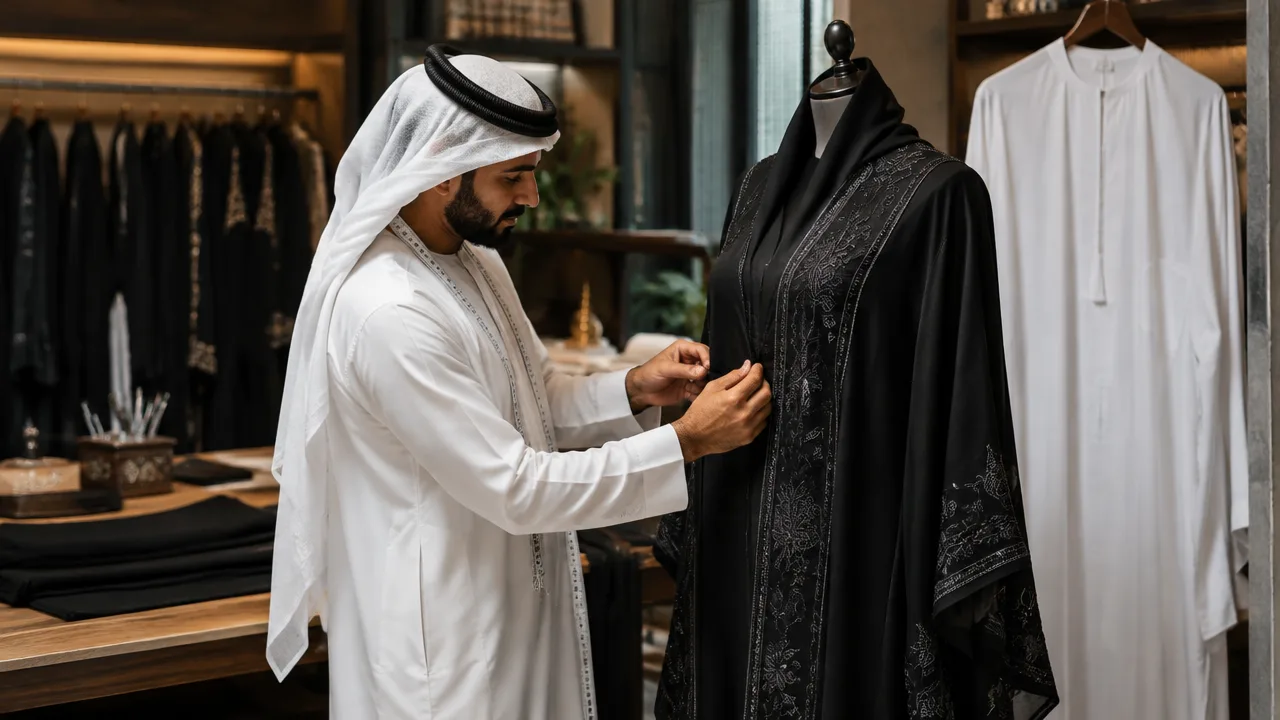
An Arabic gown atelier specialises in traditional garments such as abayas, kaftans and jalabiyas, made and tailored for individual clients. The inspected source describes activity 1410.93 as a tailoring and manufacture classification covering making, tailoring and selling this work, with no third-party approval stated. Its boundaries matter in practice: men's Arabic wear tailoring, fabric wholesale, footwear making and non-tailoring garment manufacture all fall outside it. The source also notes that a physical tailoring workshop can attract Dubai Municipality standards on ventilation, fire safety, waste disposal and staff welfare, with an inspection before operating. Demand is driven by daily wear, weddings, Eid and National Day, across both Emirati and expatriate clienteles.
Evidence scope: Meydan Free Zone, Dubai only. The inspected source states no third-party approval for activity 1410.93 and notes municipality workshop standards. This is not evidence of mainland or other-zone availability. Two Pillars Advisory FZCO is an independent business formation consultancy, not the licence issuer or a provider of every specialist activity described.
At a glance
- What the activity covers: Making, tailoring and selling traditional Arabic gowns such as abayas, kaftans and jalabiyas, cut and finished for individual clients.
- Activity type: Craft services
- Likely jurisdiction context: Depends
- Possible external approvals: The inspected Meydan source states no third-party approval for activity 1410.93. A physical workshop may attract Dubai Municipality standards on ventilation, fire safety and waste; confirm with the chosen issuer.
What you offer matters.
What this activity covers
Making, tailoring and selling traditional Arabic gowns such as abayas, kaftans and jalabiyas, cut and finished for individual clients.
A plain-English label, not an official activity name or code.
Boundaries & approvals to check
The inspected Meydan source states no third-party approval for activity 1410.93. A physical workshop may attract Dubai Municipality standards on ventilation, fire safety and waste; confirm with the chosen issuer.
Accepting commissions for men's kanduras under an Arabic gown scope; the source lists men's Arabic wear as a separate classification.
Your independent consultant: Two Pillars Advisory
Two Pillars helps you define the business model, compare routes and prepare an application. We are an independent consultancy, not a licensing authority.
The licence issuer / regulator: the competent authority
The competent licensing authority decides the permitted activity scope and issues the licence. A sector regulator may separately assess and authorise regulated services. Neither decision is made by TPA.
Choose around your operations.
Industrial licensing, environmental clearance, civil defence and product conformity apply, depending on the process.
For arabic gown tailoring: The inspected Meydan source states no third-party approval for activity 1410.93. A physical workshop may attract Dubai Municipality standards on ventilation, fire safety and waste; confirm with the chosen issuer.
Confirm the local operating route
Describe where customers, staff, premises and goods will be located. Ask the mainland issuer and any proposed free zone to confirm the exact scope and any permissions for operating outside the zone.
Map delivery across borders
Describe where the service is delivered or goods move. Confirm entity scope, destination requirements and any UAE local operations separately; international customers do not establish free zone eligibility.
Check the sector perimeter first
Describe the actual service, product and client type to the competent regulator. A commercial registration alone does not establish authorisation to deliver regulated services.
| Decision point | Mainland | Free Zone | Sectoral approvals |
|---|---|---|---|
| Who decides? | Competent emirate licensing authority | Proposed free zone licensing authority | Competent regulator, where applicable |
| Permitted operating scope | Requires case-by-case confirmation | Requires case-by-case confirmation | The inspected Meydan source states no third-party approval for activity 1410.93. A physical workshop may attract Dubai Municipality standards on ventilation, fire safety and waste; confirm with the chosen issuer. |
| Premises, people & documents | Confirm for the selected activity | Confirm for the selected activity and zone | Confirm against the regulated service or product |
| Fees & timing | Obtain a current itemised quotation | Obtain a current itemised quotation | Confirm if a separate application applies |
From scope to application.
- Define whether you tailor to order, produce collections, or both, and describe that model in the application.
- Confirm activity 1410.93 wording and its exclusions with the chosen issuer before applying.
- If operating a physical workshop, confirm Dubai Municipality workshop standards and inspection requirements before fit-out.
- Register tailoring staff correctly and keep employment contracts clear; skilled master tailors are the core of this trade.
Illustrative planning sequence; the authority may require a different application order or additional steps.
Common mistakes worth avoiding.
- Accepting commissions for men's kanduras under an Arabic gown scope; the source lists men's Arabic wear as a separate classification.
- Buying fabric wholesale for resale under a tailoring scope; fabric trading is a separate activity.
Authority information, independently explained.
Published by Two Pillars Advisory. References last checked 2026-10-27; each source’s check date and jurisdiction are shown below. Review is limited to the cited activity scope, not an approval or universal licensing assessment. Confirm current requirements directly before applying.
No affiliation, partnership or endorsement by the authorities listed.
- Meydan Free Zone: Arabic Gown Tailoring — inspected scope. Inspected body describes activity 1410.93 for making, tailoring and selling abayas, kaftans and jalabiyas; states no third-party approval; excludes men's Arabic wear tailoring, fabric wholesale, footwear making and non-tailoring garment manufacture; notes Dubai Municipality workshop standards for physical workshops. (Meydan Free Zone published scope, Dubai only, checked 2026-10-27)
- Invest in Dubai: Search business activities. Official Dubai activity search. Final activity wording and code must be confirmed here or with the licensing authority before filing. (Dubai, checked 2026-09-12)
- Dubai Department of Economy and Tourism (DET): Business licensing. Official Dubai business licensing information, including licence types and permit requirements. (Dubai, checked 2026-09-12)
Before you take the next step.
Does this cover selling the gowns I make?
The inspected source describes making, tailoring and selling the gowns produced. Selling third-party or wholesale garments is a different scope question.
Do I need a physical workshop?
Not necessarily for the licence itself, but if you run one, the source notes Dubai Municipality standards and inspection. Confirm the premises route with your issuer.
Is this the same as ladies tailoring?
They are related but distinct classifications. Arabic gown tailoring focuses on traditional garments; confirm which wording matches your actual work.